

In modern aesthetic medicine, rejuvenation no longer means exaggerated changes or invasive interventions. Today’s focus is on restoring balance, structure, and natural facial harmony. In this context, temple filler, as one of the smartest and most subtle non-surgical methods, plays a key role in facial rejuvenation—an area often overlooked, yet one of the first to reveal signs of aging.
However,hollowness in the temples can make the face appear tired, thin, gaunt, or even unhealthy, while many people are unaware of the cause of this change in appearance.As a result,restoring lost volume in this area not only corrects the temples themselves but also creates an indirect lift that makes the entire upper half of the face look younger and more refreshed.
Why Do the Temples Age Earlier Than Other Areas?
In fact,temple aging is not a superficial phenomenon; rather, it is the result of a series of structural changes across different layers of the face. Understanding this process is the key to the correct and safe use of temple filler.
Temporal Bone Resorption
With age, the temporal bone gradually undergoes resorption and loss of density. Consequently,this change weakens the primary support of the soft tissues and leads to depression in the temple area.
Atrophy of Deep and Superficial Fat Pads
Similarly,the structural fat pads responsible for a soft, youthful facial contour gradually diminish or shift. This process occurs earlier and more noticeably in the temples.
Muscular and Fascial Changes
Furthermore,the temporalis muscle, which plays an important role in the structure of this area, may lose volume over time. In addition, laxity of the fascia and retaining ligaments further reduces tissue support.
Reduction of Collagen, Elastin, and Hyaluronic Acid
The skin in the temple area becomes thinner and loses its ability to conceal the underlying volume loss. As a result, temple hollowing can be visible even in younger individuals.
What Effect Does Temple Filler Have on the Entire Face?
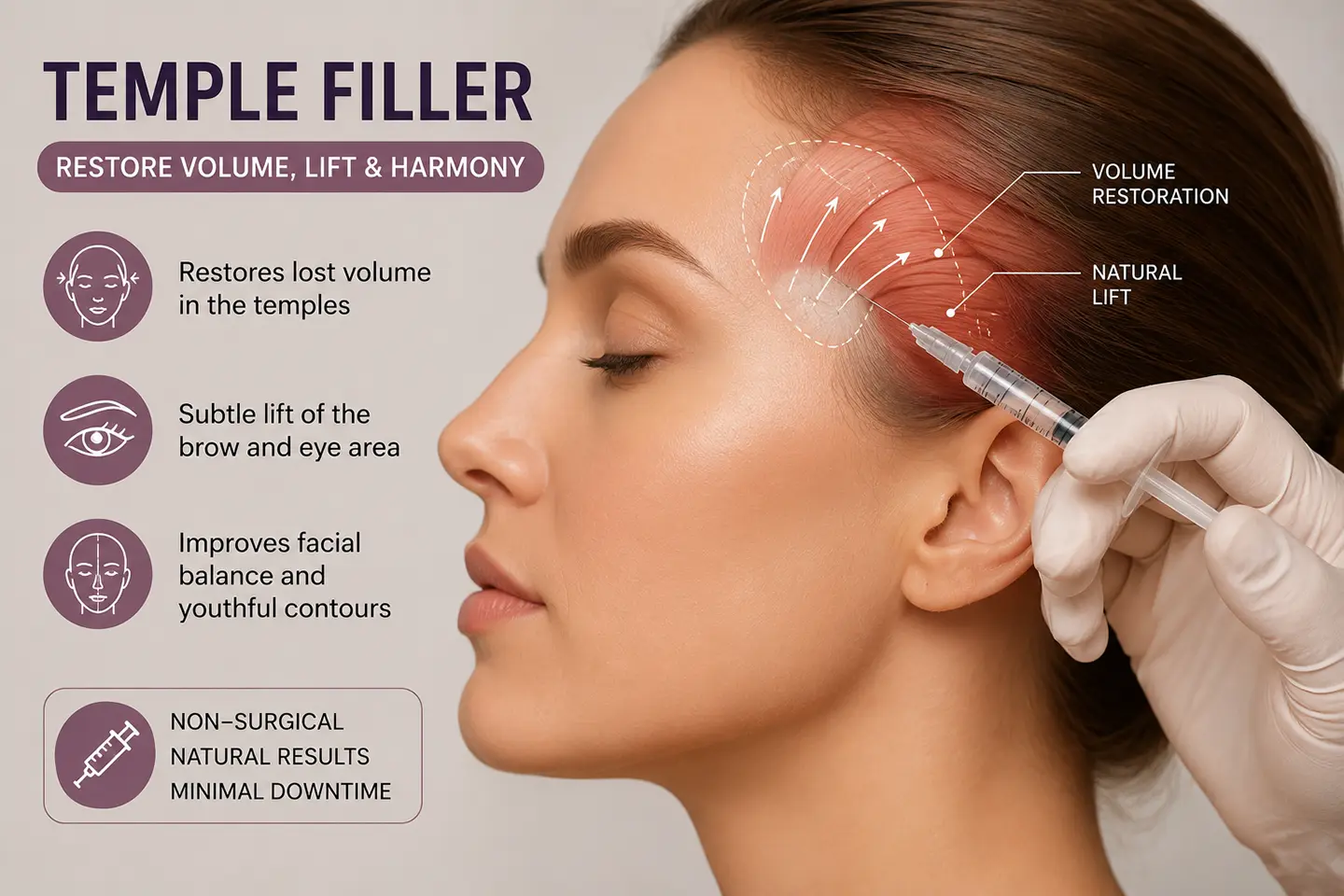
Proper temple filler injection does not correct just one area; it creates a chain reaction throughout the facial structure. For this reason, it is also referred to as a liquid lift.
Restoring a Youthful Facial Shape (V-Shape)
A youthful face is typically wider in the upper portion and gradually narrows toward the chin. Temple hollowing disrupts this balance, making the face appear heavy and droopy. Temple filler restores volume and revives the heart-shaped, youthful contour of the face, which is a core component of facial contouring.
Non-Surgical Lift of the Brows and Eyes
Temple filler subtly lifts the brow tail, making the eyes look more open and refreshed.
Improved Symmetry and Facial Framing
Full, balanced temples create a smooth transition between the forehead and the cheeks, beautifully framing the eyes. This plays a significant role in overall facial attractiveness and is often combined with cheek filler to achieve a harmonious profile.
Which Type of Filler Is Best for the Temples?
When considering filler treatments, selecting the right material is paramount for safety and longevity.
Hyaluronic Acid (HA) Fillers
Hyaluronic acid–based fillers are considered the gold standard for temple injections. These fillers are biocompatible, safe, and provide natural-looking results.
- Very low risk of allergic reactions
- Natural integration with facial tissues
- Reversibility with hyaluronidase
- Longevity of approximately 12 to 18 months
Biostimulatory Fillers
In selected cases, fillers such as CaHA or PLLA that stimulate collagen production may be used. These options require high expertise and careful patient selection.
Who Is an Ideal Candidate for Temple Filler?
- Individuals with visible hollowness or depression in the temples
- Those whose face appears tired or gaunt
- People with mild drooping of the eyebrow tail
- Athletes or individuals with low body fat percentage
- Those seeking a non-surgical lift as part of a broader face lift strategy
Temple Filler Injection Technique: Why Is the Physician’s Skill Critical?
The temple area is anatomically very sensitive and contains important blood vessels and nerves. Safe injection requires deep anatomical knowledge and advanced techniques.
Injection in the Safe Anatomical Plane
The filler is typically injected either directly on the bone (deep plane) or into the interfascial layer to minimize the risk of vascular complications.
Use of a Microcannula
A blunt-tip cannula reduces the risk of bruising and vascular occlusion while allowing even distribution of the filler.
Steps of Temple Filler Injection at Dr. Azam Khanzadeh Clinic
- Specialized consultation and comprehensive facial analysis
- Selection of the appropriate type and amount of filler
- Local anesthesia for patient comfort
- Precise injection using a safe technique
- Providing post-injection care instructions
Possible Side Effects and Treatment Safety
Common and Temporary Side Effects
- Mild swelling or redness
- Minor bruising
- Temporary firmness
Rare Complications
Vascular occlusion is extremely rare, and when safety protocols are followed and the injection is performed by a qualified physician, the risk is minimized. For more information on safety and patient experiences, you can review our patient reviews.
Frequently Asked Questions About Temple Filler
1. How long does temple filler last?
Between 12 and 18 months, depending on the type of filler and individual metabolism.
2. Does temple filler cause facial puffiness?
No. When injected correctly, it only restores lost volume.
3. Is this injection painful?
With local anesthesia, discomfort is very minimal.
4. How much filler is needed?
Usually 0.5 to 1 cc per side.
5. What is the difference between temple filler and surgical lifting?
Filler is non-surgical, low-risk, and requires no downtime, whereas surgery is more invasive.
Final Summary
Temple filler is one of the most effective yet most subtle facial rejuvenation methods. By restoring lost structure, this treatment revives natural lift, symmetry, and facial freshness. Choosing a skilled specialist is the key to achieving safe and natural results.
At the Dr. Azam Khanzadeh Aesthetic Clinic, temple filler injections are performed according to the highest scientific and aesthetic standards. Contact us today to receive a professional consultation and a personalized rejuvenation plan tailored to your facial features.